Hopefully soon visiting the countryside will be possible. Until then having this man’s portrait reminds me of better times. I can still remember releasing the shutter while he worked hard on the side of the road. We were driving in the eastern portion of the island when we spotted him working tirelessly. Even when we stopped to speak with him and ask for his permission, he continued to work without pause.
Showing posts with label Labor. Show all posts
Tuesday, November 22, 2022
Cutting Grass + Freeway, Cuba, 2010
Hopefully soon visiting the countryside will be possible. Until then having this man’s portrait reminds me of better times. I can still remember releasing the shutter while he worked hard on the side of the road. We were driving in the eastern portion of the island when we spotted him working tirelessly. Even when we stopped to speak with him and ask for his permission, he continued to work without pause.
Labels:
35mm,
Communism,
Contax G2,
Cuba,
Day Laborer,
Documentary,
Film,
Grass,
Human Rights,
Labor,
Rural,
Socialism
Tuesday, December 1, 2020
Manos + Campo, Nicaragua, 2019
El mes pasado en el cuarto oscuro ... las manos de un trabajador de 90 años en Nicaragua, cerca de la ciudad de Granada. Fue por casualidad que lo encontramos, ya que caminaba con sus vacas para pastar en su campo. Vive en una casa tradicional de madera con su hija de 70 años. La suya fue una historia increíble, y me sentí honrado de que me permitiera fotografiar sus manos.
Labels:
Campo,
Darkroom,
Documentary,
Ethnography,
Film,
Fuji,
Hands,
Hasselblad,
Human Rights,
Ilford,
Kodak,
Labor,
Nicaragua,
Photography,
Portraiture,
Silver Gelatin Print,
Zone VI
Friday, October 26, 2018
Syrian Girl + Tent, Bekaa Valley, Zahle, Lebanon, 2018
This young girl lives in the spot where my photography was born over two decades ago. This past month was my chance to photograph them again, following the documentation from last year. Her parents were the ones photographed by me so many years ago, now it was her turn. She is a young Syrian girl living in a camp just outside of Zahle, Lebanon. Her community has lived there for over three decades, prior to the current influx of Syrians from the hostilities in their homeland.
Note: This image was made with a Sony RX100M3.
Labels:
Beauty,
Bekaa Valley,
Children,
Civil,
Documentary,
Girl Power,
Girl Rising,
Girls,
Hostility,
Inequality,
Labor,
Lebanon,
Monochrome,
Photography,
Poverty,
Refugee,
Syria,
Violence,
War,
Zahle
Monday, June 1, 2015
Laborers + Brick Factory, Uttar Pradesh, India, April of 2015
These images are courtesy of my dear friend, brother, driver and translator in India, Mr. Singh. We tried several times to document a brick factory but were denied. On our way to Uttar Pradesh however we took a chance and drove into this factory to ask. The owners were different than the others, really calm and peaceful in their mannerisms. They invited us for a cup of tea, listened to our request with smiles and told us that we could come in the morning to do as we wished.
We did so and arrived as the sun came up, photographed the families near their very basic homes, made portraits with bricks as the background and then photographed the workers as they toiled under the sun and above the furnace.
I look forward to seeing these images on film, as soon as the rolls are processed.
Monday, April 20, 2015
Young Boy + Concrete Factory, Jaipur, Rajasthan, India, April 20, 2015
Just a few hours ago we arrived to Jaipur from the Muzaffarnagar region of Uttar Pradesh, and landed in a familiar neighborhood near to our wonderful host. We went straight to our favorite family and asked to photograph their daughters with only thirty minutes of sunshine remaining. Without any hesitation whatsoever, the father agreed although he had only met us for a few minutes over three weeks ago.
We walked over to the cement factory's wall and set up our camera. We photographed three of the five daughters before the sun was too soft for my film camera, and then went on to photograph some other children for fun with the digital camera. This portrait is of the most mischievous ones from the bunch, finally put in front of the lens for all to behold without his usual antics to protect him!
He was marvelous, and truly enjoyed his time in the spotlight!
Note: This image was made with a Sony RX100M2 just five hours ago.
Sunday, January 25, 2015
Guajiro + Tools, Matanzas, Cuba, Summer of 2014
In between photographing dancers on the beach and cars in the streets, Alejandro would take me to the countryside in search of the rural life. The results, often slow to develop, were deeply satisfying and made me regret that we waited for the last two weeks to do so.
This man was working with others to the side of the road, clearing the brush and small trees from a local farm. We asked the manager for permission, and she gave it to us without resistance. She even allowed us to make her portrait with a smile.
As I finished this man's portrait, he began to sharpen his blade, giving me a chance to make that image as well. The pace of photography in rural Cuba is different, more casual, and moves me to do much more this summer on the island. We hope to find him and his friends, and hand them these images.
www.halimina.org
Labels:
Countryside,
Cuba,
Documentary,
Ethnographer,
Farmer,
Farming,
Fuji,
Halim Ina,
Hasselblad,
Labor,
Monochrome,
Neopan,
Photographer,
Photography,
Rural,
Zeiss
Tuesday, January 15, 2013
Child and Strip, Banjara Community, Humana People to People, Rajasthan, India, November 21, 2009
Instead of finding the children near the homes, we saw a small bus taking the children to school. On this day it so happened that they went into the nearby town for classes, instead of working on the streets. I was of course happy to see this, even though my intent was to photograph them. We talked to the only adult in our presence for a little bit until he felt comfortable enough with our intentions.
A group of perhaps six children came along and sat on a thin strip for their portraits. The sun by this time had reached an uncomfortable angle and we did our best to get the children to laugh, the best way to get the eyes to relax in the sunlight. We photographed for less than thirty minutes and then set out to find a couple of government schools in which to work.
The Banjara Community has affected me deeply since my first visit to Rajasthan almost seven years ago. Their independence from the local communities is clearly visible even for a visitor such as myself. They keep to themselves and seem content doing so. At a local bus stop they chat amongst themselves, laughing wonderfully and presenting themselves much less formally than the others sitting around the tea shop.
Their children are incredibly beautiful, and wear the most gorgeous outfits. The patterns range from floral to space age, always abstract and colorful. The skirts are tightly pleated while the shirts fit so tightly against their small torsos. I will return year after year to photograph them, and hopefully build a larger portfolio than the one presently in my possession.
Halim Ina Photography
Friday, December 28, 2012
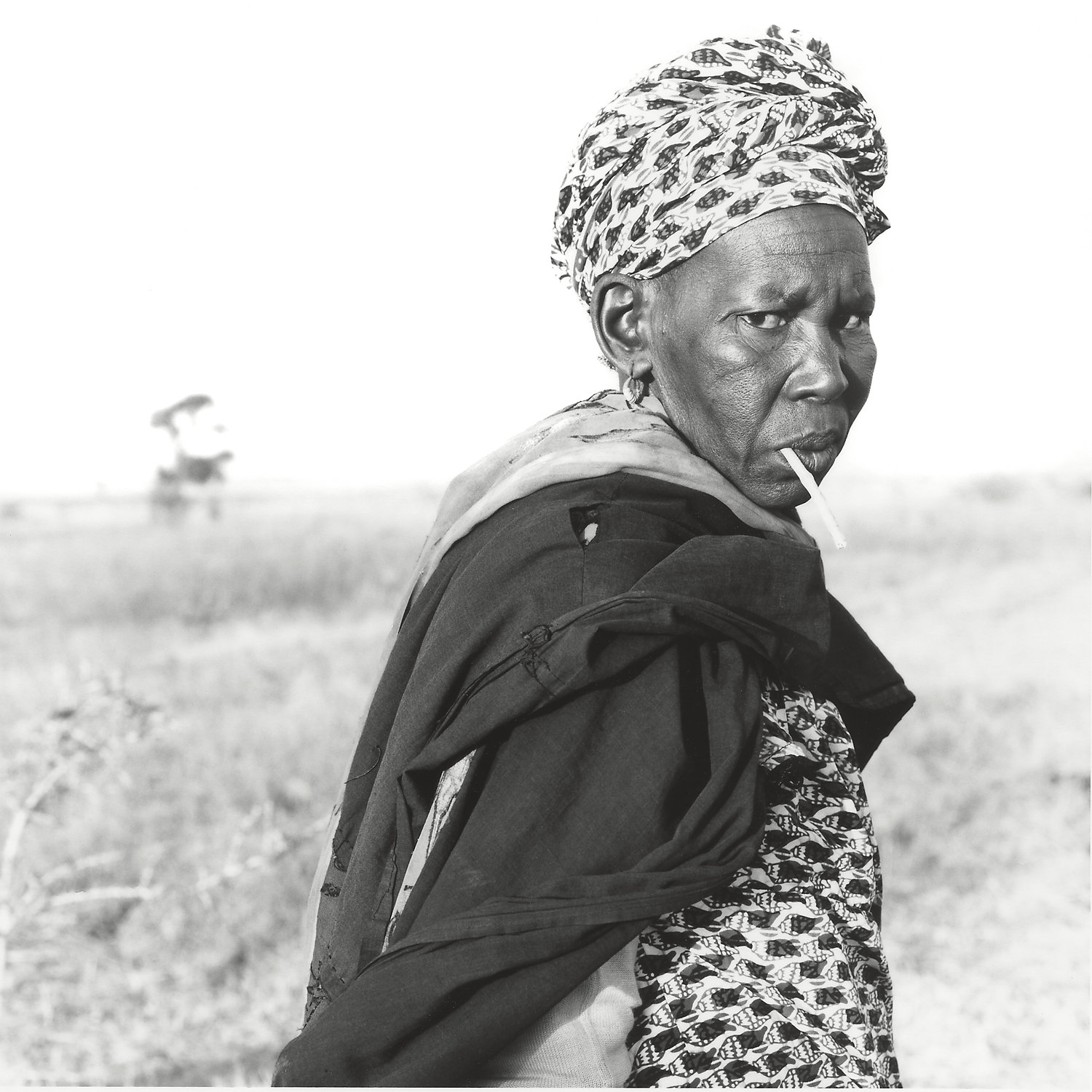
Woman, Water Collection, Somewhere in Senegal, 2006
We were on the road for just a little bit when we can across this woman and a younger companion near a water well. They were just finished with water collection when we arrived, and let us speak with them for a few minutes. They then allowed us to make their portraits, giving us just enough time to set up before walking away.
She was doing just that when this image was made. My memory tells me that she has a natural toothbrush between her lips, the brand that's sold on the streets in bundles by vendors. The area around us was as seen in the image above, open and expansive. We were on our way to the interior of The Gambia and had a long road ahead of us.
Much of my work today is planned, scheduled and repeated. The people in my portraits are familiar to me, and I can identify their streets and homes from a satellite view of our globe. Her portrait and all other portraits from my time in Senegal are more mysterious. I will never be able to visit this place again, and am thankful for at least this image.
Perhaps I should refrain from using the word never, because I do have family in Senegal and they do remember the driver. He might just remember the path taken and just might be able to take me once again to this well. Regardless I have come to accept these single portraits, and cherish them actually. There are so many more spirits to document, that she will forgive my absence I believe.
halim.ina@gmail.comShe was doing just that when this image was made. My memory tells me that she has a natural toothbrush between her lips, the brand that's sold on the streets in bundles by vendors. The area around us was as seen in the image above, open and expansive. We were on our way to the interior of The Gambia and had a long road ahead of us.
Much of my work today is planned, scheduled and repeated. The people in my portraits are familiar to me, and I can identify their streets and homes from a satellite view of our globe. Her portrait and all other portraits from my time in Senegal are more mysterious. I will never be able to visit this place again, and am thankful for at least this image.
Perhaps I should refrain from using the word never, because I do have family in Senegal and they do remember the driver. He might just remember the path taken and just might be able to take me once again to this well. Regardless I have come to accept these single portraits, and cherish them actually. There are so many more spirits to document, that she will forgive my absence I believe.
Halim Ina Photography
Labels:
Africa,
Dakar,
Documentary,
Girls,
Halim Ina,
Inequality,
Labor,
Oppression,
Photographer,
Photography,
Rural,
Senegal,
Sex,
Toothbrush,
Tribe,
Water,
Women
Thursday, October 25, 2012
Michel, Metalsmith, Family, Bekaa Valley, Zahle, Lebanon
He has since passed on, but this portrait is etched into my mind. In the early years of my work, my Mother's hometown was the starting point. Visiting the family seemed like a good excuse to take along a camera and head into the streets while they were either working or sleeping.
Language was never a barrier, and people knew my family well. Safety was nothing to be concerned with, and walking in the streets was as natural as I had remembered from childhood. Everywhere I turned someone greeted me with a smile, acknowledged our common thread as Lebanese. Most were curious and conversations would begin very easily.
In this instance this man was working in his shop as a metalsmith. I asked him for his portrait and he offered his time happily. We talked for a few minutes then set up the camera to make the image above. In the middle of setting up he asked about my connection to Zahle. I responded with my Mother's maiden name and, as it turned out, he happened to be related to my Mother as a close cousin. He asked about my family, and then asked if perhaps he should change to more proper clothing for his portrait. I assured him that my Mother would love him as he was, and respect him even more so for allowing her son to make his portrait without doing so.
We worked for a little bit, talked more so and promised to see each other the following year. I returned home to tell my family that I had photographed Michel, and noted the smiles on their faces. They were used to me photographing migrant workers, unknown faces, and were in disbelief that my work now included our family. My Mother however knew my work and was sincerely pleased that I had finally included my own family alongside the endless stream of strangers.
I visited Michel every time we returned to Lebanon over the years, sometimes just passing by his shop and seeing him hard at work. Then one year I heard the news of his passing, that a car had struck him while walking down the narrow street of his shop. I was upset because I have seen firsthand how careless drivers can be on these streets, and knew that he had so much more to give. I admired then and admire even more so now his work ethic, how he cared about his job whether he was working for a prominent farmer or a migrant worker, taking care of their respective tools.
One year I returned with his framed portrait to give to his wife. My Mother gave me directions to his home and I decided to go alone. I knocked on the door and a young African answered the door. After exchanging greetings I asked for Michel's wife. She returned a minute or so later and looked at me in a curious manner. I took the framed photograph and placed it in her hands, the entire time looking at both of their faces. This was the first time that they had seen the image and were so surprised that Michel had been photographed.
The look on their faces was sufficient in itself, and we separated without saying much more. This experience showed me that people do cherish the visual record, and even more so the fact that one took the time to return their loved ones to them. This I do with honor, and pleasure.
Labels:
Asia,
Bekaa Valley,
Documentary,
Elderly,
Equallity,
Halim Ina,
History,
Humanity,
Labor,
Man,
Photography
Friday, September 7, 2012
El Trabajador, On the Road to Pinar del Rio, Cuba, July of 2008
In my last few days on the island I decided to head out on my own to Pinar Del Rio. It seemed easy enough, nicely paved roads and neatly placed signs. Heading west from the hotel and without a map, the feeling was a mix of anxiety and excitement.
After getting out of the city, everything cleared up... the skies, the roads and the air. Every now and then I would stop and speak to a few men, ask their permission to make images. Without exception everyone agreed regardless of my limited Spanish at the time. On this occasion a group of workers were cutting the grass manually.
For a monthly salary equal to an average pair of pants, they are responsible for the grass on this stretch of highway. In addition to the work accomplished on their farms, they would come out in groups on certain times of the month and cut the grass. This of course is done under the grueling sun and during the hot months of the Caribbean, when the grass grows most quickly.
We went on to collaborate for perhaps thirty minutes, after which time I bid farewell to them and continued west. For me the rest of that day was easy, driving around in a car with the wind blowing, keeping me cool. I drove for a few more hours and then turned around to head back to the city.
All the time I couldn't help thinking that these men continued their work until the sun went down, then returned to their farms to do more of the same. I have a deep respect for these men and others like them, men toiling under the sun without rest and only with the hope of providing for their families.
Halim Ina Photography
Subscribe to:
Posts (Atom)