Showing posts with label Culture. Show all posts

Wednesday, November 9, 2022

Banjara + I, Behror, Rajasthan, India


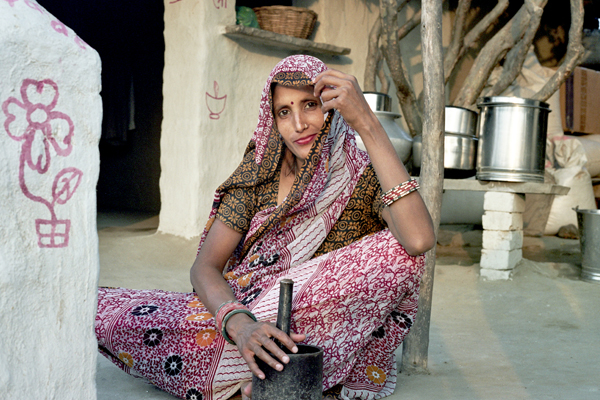
My friend Niranjan Rajput thankfully made this snapshot of the girls and I after the photography. The expressions say it all, especially that of the girl at the end!

In the beginning, this specific tribe is associated with a foundation school near Behror, Rajasthan. Later they move further away in order to remove themselves from the urban chaos and in search of their more traditional way of life.

This results in their children losing access to the foundation's school, one in which they are enrolled for about three hours per day, outside of their daily chores and work duties. While outside of class, these children collect plastic and so forth in order to sell in bulk later. They also approach certain people for donations in the streets.

As noted in Wikipedia, 'women are known to wear colorful and beautiful costumes and have tattoos on their hands.The dress is considered fancy and attractive by Western cultures. They use mirror chips and often coins to decorate it. Women put on thick bangles on their arms [Patli].Their ornaments are made up of silver rings, coins,chain and hair pleat are tied together at the end by Chotla.'

Tuesday, September 6, 2016

Ballerina + Field, Santa Maria del Mar, Cuba, 2016

Working with this young dancer and her friends here in Cuba continues to inspire me, 8 years after the first images of ballerinas were made. Hope to share much more soon!
Note: This image was made with a Sony RX100III mounted next to and triggered at the same time as a Hasselblad analog system.

Tuesday, February 19, 2013

The Sheikh and his Daughter, Bekaa Valley, Lebanon, Summer of 2009

I have known this man and his family for over sixteen years. In this small, tent city my photography was born. Since we first met five of his children have been born, including the young girl standing next to him. He is a brother to me, as she is a daughter.

Along with my blood family nearby, these are the faces that greet me in Lebanon. The expression on her face is the expression she shows me time and time again. She is aware of my love for her, and he allows this love to be expressed. In my travels this is quite rare, regardless of culture or location.

As a matter of fact, during this visit it happened. We were walking back from the end of the dirt path towards this very spot when she looked up at me and said these words: 'you are my father, my uncle and my brother.'

She said these words without pause in response to my words: 'you are my mother, my sister and my daughter.' This is how comfortable this family allows me to be. While the work can be difficult at times, should anything happen that makes me feel like leaving, one conversation with this man and everything is straightened out.

On one occasion his own brother and I argued and it seemed that my work was finished. When he caught wind of the argument, he took it upon himself to call a meeting with the elders of the village. They listened to both sides and allowed me back into the village and into the lives of their girls.

This summer will mark three years since my last visit, and due to the instability in the region this year it seems improbable once again to visit. These wonderful people are Syrians living in Lebanon for the sake of work. Their girls work in the fields at least twelve hours a day while the boys work in various shops around town.

They live incredibly difficult lives, and do with the minimum while working in Lebanon until their return to Syria. It seems that this return is in peril at this moment, but my hope is that peace returns to their homeland and that they are safe while in Lebanon.

halim.ina@gmail.com
Halim Ina Photography

Friday, January 4, 2013

La Maestra, Escuela de Modelaje, La Habana, 26 de Julio, 2012


Three years ago I met this incredible woman through a mutual contact, one of her students. We were invited by this student, one of the subjects from my work the previous year, to attend the last day of lessons and a presentation for the parents of the students.

We arrived at the school and sat down in between the parents. The main room was arranged for a fashion show, and soon we would see our model as well as the rest from this school. The wonderful woman above allowed us to make images during the show, and we did so without the use of flash. Although we worked from a distance and without much notice, the parents were curious about our presence.

The young women and girls walked beautifully, and displayed the knowledge passed on by their incredible teacher. It was obvious to me that these students were quite proud of their performance, and deeply appreciative of attending this school. The respect shown to the teacher from the students was clearly visible, and admired by me very much.

After the show was over, we walked to the courtyard where all of the students and parents were gathered. My friend was engaged in conversations with a few of the parents and they showed serious interest in our work. We showed a few albums to them, and the level of interest increased even more. My friend asked me if we would arrange a session later in the week... and my answer to him was immediate: why not now!

The courtyard was the perfect place, with one tall white wall reflecting the sun beautifully like a giant soft box. We set up our cameras and began photographing each student, one by one, for perhaps less than one minute. We managed to photograph all of the students within one hour, and then made arrangements to return on another day for a more complete session.

We were shown incredible respect by all, and most of all by the teacher. She spoke with me like a dear old friend would speak with me, with kindness and understanding. She seemed familiar with my work, perhaps with my mindset. We returned a few days later with images from both sessions and presented such to her. She thought we were only showing them to her, until we insisted that she keep the images for her school and for the students. She was just incredible.

This past summer we visited once again the school, and made arrangements on several occasions to photograph in private a few other students. Our access to the students and to the parents was unlimited, and we managed to arrange four sessions altogether. The last of the sessions included the teacher and two of her students. We picked them up at the teacher's home, then drove out to the Pan American Stadium once again for the afternoon.

Watching her work and then the students move was enlightening. While the students did beautifully, it was obvious to all present that true talent existed only in one at that moment. Even though she had perhaps decades of experience compared to my limited time with fashion/modeling, she allowed me to suggest certain spaces and themes. We worked at the entrance to the stadium, on the grand stairs... then moved to a small white supply building for that famous white wall facing west.

We worked for almost two hours and then headed back into town. Rather than being dropped off first, she chose to drive with us while we dropped off her students... almost an hour and a half of driving due to the distance between their homes. She was so patient and never complained. Her voice was soft and sublime, always speaking with a smile.

I look forward to years of collaborations with her, and cannot imagine what we will accomplish.

halim.ina@gmail.com
Halim Ina Photography

Sunday, December 30, 2012

Young Girl, Corn, Konso Tribe, Lower Omo Valley, Ethiopia, February, 2010

She sat down on a small stool provided to us by the community. Perhaps over sixty people were standing less than four meters to her right, and twenty or so to her left. Their shadows would sometimes enter the frame, giving us pause until we could reorganize the scene once again.

Chaos it was since this was one of our first villages together, and the sound was almost deafening. The fact that the spoken language was unusable to me anyway made the situation more workable. In order to help the children feel comfortable and at ease, hand gestures would be used along with a smile. Running around to organize the scene like a fool helped a bit also, even though organization was the last effect of my actions.

In the end we made wonderful portraits in an open space, a place to which the community took us when asked about such an area. In this village the spaces are so tight that one needs to be careful about walking into sharp, hard and seemingly chaotic branches that make up the houses and fences. All of the children were running past me so quickly while I walked at a snail's pace to make sure my eyes remain intact. It was incredible, the energy.

The space was beautiful, open to the rising sun and with trees all around. The community shared with us a stool on which the people would sit for their portraits. One by one they came, some voluntarily and some at my request, some more shy than others.

She was sweet, and thought that we'd want to make a portrait of her without the goods that she was carrying. To her surprise we wanted both and this made her smile the entire time. Environmental portraits are usually outside of my work, but had been included more so in the past. I am now returning to this approach and will do more of these portraits in the near future.

When every person was finished with the portrait, I walked over to them to help them up and to also shake their hands. In this way their skin touched my skin, and when I do so in India or in Cuba that energy will be transferred to yet another developing experience. When I tell the children this in almost every single case they smile.

According to Wikipedia:

The Konso mainly reside in Ethiopia's Southern Nations, Nationalities, and People's Region, south of Lake Chamo in the Sagan River bend.
Although there are today marked differences in customs between the Konso and their Oromo neighbors, Konso society has also retained some commonalities with traditional Oromo culture. The latter include the gadaa generation-grading system of social organization, similar high priests and a cult of phallicism.
Konso society is largely agricultural and involves the irrigation and terracing of mountain slopes. Staple crops include sorghum and corn, with cash crops including cotton and coffee. Cattle, sheep, and goats are raised for food and milk.
Polygyny is an accepted practice among the Konso.
Group members also erect carvings (wagas), which are created in memory of a dead man who has killed an enemy or animal. The statues are often arranged in groups, with statues representing the man, his wives, and his adversaries present.
In terms of creed, the Konso practice a traditional religion centered on the worship of Waaq/Wakh. In the related Oromo culture, Waaq denotes the single god of the early pre-Abrahamic, montheistic faith believed to have been adhered to by Cushitic groups.

halim.ina@gmail.com
Halim Ina Photography

Thursday, December 20, 2012

Widow, Mosque, Zakat Foundation of India, New Delhi, India, November 26, 2008

In the courtyard of a small mosque in Old Delhi this work was accomplished. The women and a few men, all widows, gathered to receive a bundle of dry goods to help sustain them for the next month. This work was made possible through the generosity of good people and the organization power of the Zakat Foundation of India.

The foundation arranged the day to coincide with my visit, and during the distribution of dry goods. As in the previous year we asked permission to use the local mosque's courtyard since the outside scene was beyond chaotic. To set up a tripod and make a photograph outside would be the equivalent of doing the same during the 'Running of the Bulls,' with only the slightest of exaggeration.

Thirty or so women and a few men gathered for their portrait. We used a light wall against which the women would stand, and set up the tripod perhaps three meters away. To my right was the basin in which the men would wash their feet and hands, and to my left was the entrance to the mosque. Behind the women and to her right was the entrance/exit to the courtyard.

We tried to pick the least cumbersome spot, but would inadvertently get in the way soon enough. About halfway through the session an older man walked over and told us that we needed to stop, that prayers were about to begin. He seemed to be the only one with the request, as I scanned the courtyard and received nothing but kind, generous faces in response.

He however kept at it, and what made it worse was that I had photographed him the year before and had his portrait in my bag, in a protective sleeve. He continued and continued until I finally had to break away from the work, go to my bag and pull out his portrait. I handed it to him with a sense of agitation and with a face that basically spoke of my disappointment. Here he was getting in the way of the women's portraits when he himself sat for his one year earlier.

A few of the men kneeling down saw this and made my day when they smiled with approval.

We then went forward with our work and finished photographing the rest of the women. What impressed me most was that none of the women walked away from the scene. They stood by me and the good people of the foundation, and demanded with their presence to continue with the work.

Such is the woman above, and for this detail alone she has my deepest respect.

A link to the foundation and to more work from this collaboration can be found through my website below.

halim.ina@gmail.com
Halim Ina Photography

Monday, December 3, 2012

Another Side of Mariel, El Mirage Dry Lake Bed, Los Angeles, November 18, 2012

Just when I thought we were finished for the afternoon Mariel decides to produce an array of expressions with her face, in very much the same way she had produced so with her body for the first part of the session. She moved from one expression into another with such power, and dignity.

She is a professional, acknowledged my reactions and incorporated them into her next gestures. Her light eyes stood strong against the sun even though most would fold under such intensity. We had worked for over two hours by the time of this portrait yet she was unyielding in her output. When offered rest, she kindly insisted to continue with our work.

In comparison to the digital platform, moving at such a pace in the analog equivalent required reloading the film back over and over again. Rather than losing momentum Mariel would continue to move while I reloaded the film back. When I returned to the viewfinder she would be ready to show me much more and with an exuberance that made working with her the equivalent of working overseas.

Here is a woman, photographed literally hundreds of times by dozens of photographers. Rather than placing herself above those in my portfolio from around the world because of her experience, she embraces them by approaching this project with humility and respect. She never once asked me for a hair stylist, but rather let her hair flow freely in the wind. She had every right to do so, and such a team is an incredible asset to a photographic collaboration. However she recognized the meaning of my work and wanted to be one with the women and girls in my book.

On this day she achieved this most successfully and has earned my sincerest respect. We shall collaborate for years to come, and have plans next year to initiate a workshop in the Los Angeles area to raise funds for schools in India. On her support the girls of Rajasthan can depend, and have found a sister across the oceans.

As her essence passed through the glass elements of my lenses, she joined those in my portfolio in their struggles, in their joys. To learn more regarding my work, and the projects represented through these images, you may visit the website listed below.

halim.ina@gmail.com
Halim Ina Photography

Dreaming Mariel, El Mirage Dry Lake Bed, Los Angeles, California, November 18, 2012

While most would think twice about driving over two hours to a location, this young woman accepted the drive initially for our morning session. This meant leaving by four in the morning and returning well after two in the afternoon. She accepted without hesitation, always helping me feel comfortable in my attempts to make our arrangements ideal.

Perhaps by chance or perhaps by fate, the afternoon cleared for us to work and Mariel once again accepted without hesitation. We met by her apartment early in the morning nonetheless and began our three hour drive to El Mirage Dry Lake Bed just outside of Los Angeles. We stopped for coffee and hot chocolate, and chatted like old friends along the way.

When we arrived I was worried that maybe the lake bed would be closed due to the recent storms in the area. To my pleasant surprise the lake bed was open to the public, unlike my last visit to the area. We drove onto the lake bed, always to the side in order to preserve the integrity of the surface. We headed to the end of the bed where few would be around, and set up for our session soon after.

Mariel took a few minutes to prepare herself and was ready quickly. The angle of the sun was low and allowed us to work immediately, and throughout the afternoon. We began with an elegant black dress, and I soon learned that Mariel shed her inhibitions during her sessions. She began the session standing up and then laid down on the surface for a different presentation. Rather than worrying about the dust on the fabric, she embraced the dust and gave me yet another dimension to the images.

Then, for the image above, she returned to the car in order to gather an incredible piece that she had recently acquired. The wind, while ideal in most instances, made it quite difficult for Mariel to manage. Like a professional she managed beautifully, at times using her hands to stabilize the piece while adding lines, volume to the exposures.

She never complained, never once told me that we needed to finish early. We worked for almost three hours and then decided to end our session with peace in our hearts. We packed up our gear and headed back home, also chatting along the way. Some find it awkward after a session, since so much output is needed leaving one with little energy to talk. This exquisite woman understood the essence of my work and therefore quenched my need to learn about her. 

I very much look forward to printing more of her work, and to collaborating once again early next year.

halim.ina@gmail.com
Halim Ina Photography

Friday, September 7, 2012

El Trabajador, On the Road to Pinar del Rio, Cuba, July of 2008


In my last few days on the island I decided to head out on my own to Pinar Del Rio. It seemed easy enough, nicely paved roads and neatly placed signs. Heading west from the hotel and without a map, the feeling was a mix of anxiety and excitement.

After getting out of the city, everything cleared up... the skies, the roads and the air. Every now and then I would stop and speak to a few men, ask their permission to make images. Without exception everyone agreed regardless of my limited Spanish at the time. On this occasion a group of workers were cutting the grass manually.

For a monthly salary equal to an average pair of pants, they are responsible for the grass on this stretch of highway. In addition to the work accomplished on their farms, they would come out in groups on certain times of the month and cut the grass. This of course is done under the grueling sun and during the hot months of the Caribbean, when the grass grows most quickly.

We went on to collaborate for perhaps thirty minutes, after which time I bid farewell to them and continued west. For me the rest of that day was easy, driving around in a car with the wind blowing, keeping me cool. I drove for a few more hours and then turned around to head back to the city.

All the time I couldn't help thinking that these men continued their work until the sun went down, then returned to their farms to do more of the same. I have a deep respect for these men and others like them, men toiling under the sun without rest and only with the hope of providing for their families.

For more of my work, please visit the newly designed website below, courtesy of Patrick Luu.

Halim Ina Photography

Thursday, September 29, 2011

Mother, Friend, Sister of Teacher, Banganga Village, Rajasthan, India, 2009

She works to make tea for us, and lifts the garment for a split second.

We are looking at the front of her home, the kitchen area. She never ceases to work, moving from one task to another without pause. Four years she and her family have been in my life, and now she smiles at the thought of being photographed by me.

Her sister lives next door and is a teacher for Humana People to People India. It is through her sister that we meet. When I visit their homes they make two cups of tea for me, two meals as well. They watch me finish the first and then try to finish the second. They sit around me smiling at the amount of water going down my throat along with the food. They know that their food is a bit spicy for me, but that I love it nonetheless.

In their presence I feel at home. I can walk anywhere and photograph anyone without asking. I have been there as the sun began to rise and stayed until it set. They have been the first village in my trip and also my last. I have walked hand in hand with their girls, and sat alongside the men having conversations.

Her family owns a large portion of land, the same with her sister. They do quite well and are respected highly in their village. Rather than hiring others to help with the work, they do everything themselves. Everyone helps. The girls are always cleaning, making the home neat and comfortable. The men are constantly tending to the land, to the animals.

They recycle everything, cook extravagant meals for the oxen and always keep each other company. They are constantly together, and find happiness in this. The daughters of both families are like sisters as well, and I find it hard at times to differentiate between the families. In all of my experiences with these two families, I have always felt joy and kindness.

The girls attend school without question. Before the birth of the only boy, these two families had only daughters. Rather than seeing this as a calamity, these two families have made this small corner of the world a paradise for the girls. They have the support of their mothers and their fathers, and the love is deeply felt. 

When we leave after each visit, all of the girls and their mothers walk to the edge of their property, bidding us farewell. They continue to do so until they cannot see us, always with smiles on their faces. Perhaps one day I will return to this part of the world and stay a while longer. I can imagine waking up the next day and seeing them all around me, rather than worrying about heading back to town before the sun sets. 

I want to see them grow up and have children of their own. Then I can photograph all over again. 

halim.ina@gmail.com
Halim Ina Photography

Friday, February 25, 2011

Child, Student, Banjara Community, Rajasthan, India, November 25, 2008, Roll 1, Exposure 12


So many of their children look like any children from around the world.

Here is a child that belongs to the Banjara Community, can be from anywhere and from any family. Earlier this day, we stop by the side of the road for some oranges and apples. The people from the foundation tell us to stay inside the car because outside of the car we will garnish attention.

We decide to ask for forgiveness and walk with them to get the fruits. As we do so we of course witness their warning up and close. A few children gather around us and start their usual hustle, all in good jest and with genuine intention, for they are only trying to support their families.

One of them looks at me differently, recognizes me from last year. At that point the book of images from last year is shown to them and they begin to laugh, realizing that some of their friends are in that book. A few strangers take note and wonder what this outsider has in common with these young street children. We ask them if they are going to be in school later in the afternoon and they all give us the affirmative in the sweet Indian style with their heads.

We bid them farewell and go looking for a specific child. A few of the children a little further up the road recognize her in my book and point us in the correct direction. We locate the young girl's village and arrange to return the next day for some photography. Afterwards we return to that street corner and locate the children from earlier in the day.

Their encampment is kind to us, allowing our photography amidst the chaos. Voices are everywhere and people are running behind the subject and in front. The people from the foundation are certainly more nervous than me since they are the ones speaking directly to the people. Forgiveness can be granted to me since I am a stranger and lack further understanding.

Nevertheless all goes well and a chair is even located for the children to stand upon for their portraits, giving their faces access to the sun in the middle of the crowd. One such face is the child above, from the Banjara Community but resembling the face of children everywhere.

We will return and photograph this community, for they are on my mind day and night.

Thursday, February 24, 2011

Banjara Woman, Rajasthan, India, October, 2009


The image above is a still from moving footage. While we are on this day unable to make still images of this group, they allow us to film them during their tasks. The rest are standing to my left and she watches them as they watch her, all the time making three pieces of bread at the same time.

My friend tells me that she is able to place one on top of the fire, one inside the fire and one in her hand in preparation for the fire. Watching her as the camera records her movements proves this to be true.
From this home we move on to photograph a few children nearby, some of whom follow us from this home. It seems that they too want their portraits made but, without the men from their homes, are unable to do so.

Earlier in their history, the Banjara Community were known as the salt traders, moving this and other commodities from one part of India to another, going as far as China and Europe, even to the United States. Many consider them the ancestors of the Roma Community throughout Europe and of nomadic groups around the world.

The literal meaning of their name is: 'One who moves or wanders in the jungle.'
Soon, perhaps in the next two years, they will be a focus of my documentation more so.

Friday, February 4, 2011

Kate, Artist, Sister, Friend, North America, 2011


Over the past two years we go back and forth, exchange messages now and then, starting conversations but never end them.

Then a few months ago, she sends an email to me as a start of another conversation, one that we are still having to this day. There is distance between us both in terms of land and in terms of generations. Regardless we speak in a common language, she understands this work fully.

She sees the girls in my portfolio as queens, as princesses. She understands the use of neutral backgrounds and just this past week decided to pursue the same in a tribute to the women in my portfolio.

Out of respect, she uses a male friend rather than a woman. She spends two hours of her time in the cold to make exquisite portraits, in the style of my work. She then waits until my arrival home to send me an excited message, to visit her blog and experience this surprise.

This young woman's name is Kate and she is a princess alongside the girls in my portfolio, we will continue the conversation this evening. Should you like to learn more about her, you may visit her blog below.

Kate Med Photography

Friday, October 15, 2010

Miss Dayna, Daughter, Sister, Model, Orange County, California, October 14, 2010


This is my second day in California photographing women from the West to put alongside their sisters from the East. A young woman named Miss Dayna visits with us and allows her portrait to be shared with the people in my portfolio; she is especially taken by the young Dasanech girl in the above portrait and chooses her print to take home with her at the beginning of the session.

The young woman from Orange County is anything but a stranger. She sends me a note in response to seeing my portraits and immediately accepts to have her portrait made. Even though she is leaving the very next day for a tour of the East Coast through her modeling, she gives of herself for almost four hours today for the sake of her sisters in my portfolio.

She is happy to learn that we want to drive to her area and provides us with a place to photograph according to our specifications. While waiting for her to finish a few necessary tasks for the next day, we decide to drive around a little bit and find a natural setting for her portraits. We drive up to a spot and see a perfect, small hill. We decide to turn into the park and find it to be completely accessible.

So we contact Miss Dayna only to find out that the park is her childhood park, that she grew up playing in this very space. She is so happy to learn of our choice and arrives a few minutes later, ready and completely prepared with a perfect wardrobe, dark and simple.

We work for the next three hours, climbing hills and going between dry bushes with sharp edges. She braves all of it with the most ethereal of smiles. While the sun is shining strong, she maintains her gentle nature, always laughing and keeping the session light and professional. She is to be greatly respected and has now joined the family of portraits she has so admired.

The women in my portfolio will soon see her portrait, her spirit and, most importantly, her smile.

What a gentle soul!

At the end of our session, she learns of the fact that we have never visited an In-N-Out. After a few questions, she immediately plans out our order and organizes a trip to the nearest location. We follow her on the highway for two exits and end up having a wonderful dinner together. She has the curiosity of a young girl and just smiles from ear to ear at our reactions. What a meal!

At times the photography takes on a life of its own, this afternoon was one of those days in great thanks to Miss Dayna.

Sunday, June 27, 2010

Widow, Courtyard of Mosque, Zakat Foundation of India, Old Delhi, India, November, 2008


Just like her counterpart below, this woman is shunned by her society and is placed in a situation of need as a result. She comes to gather her bag of dried goods for the next thirty days, until she needs to return the following month.

This is her second time in front of my camera and in the very same spot, the courtyard of a local mosque. The scene outside of the courtyard is one of madness and extreme difficulty in terms of photography, so we choose a place that allows us to make portraits in peace.

However, as our session extends into the second hour, men start to gather inside the courtyard for prayer. Because of timing issues with the foundation, we still have a dozen women in need of photography. Men begin to complain about the camera and also the presence of women in their midst.

One man especially does so a few times, loudly in fact. He continues to do so and his face is familiar to me, he is a face from last year's photography. So instead of asking my translator to quiet this man down, his picture is found in my bag and handed to him quickly by me.

He quiets down immediately, albeit with a sense of disgust, and walks away.

A few men sitting down for their prayers smile as a result.

Sunday, April 4, 2010

In the Midst of Prostitution, Rajasthan, India, November 6, 2009


In the midst of Prostitution, this portrait is made. Behind her is a building with a dirty, white wall. The negative is exposed to take advantage of such, erasing any remnant of her surroundings and allowing her to shine without limitations. This is her second portrait today; she has changed into a darker shirt, combed her hair and returned with a wide grin. 

There are those that question my requests many times. 

Why do you ask them to change their blouse? Why do you insist on darker colors? What if they have nothing other than what they are wearing? What if they like what they are wearing? 

 My answer to them is her smile. Asking her to be involved in her portrait respects her; including her in a wardrobe decision allows her to make that decision rather than be 'found' on the street. Proposing darker colors allows her features to dominate the portrait rather than be dominated by visually strong elements. Most of the children in my work will never see a photographic studio, will never have their portrait made. This is a chance to play, an opportunity to experiment with colors, fabrics and expressions of personal preferences. When asked, many girls waiting in line will then exchange fabrics, pieces of clothing. Giggling dominates along with smiles. 

My experience in the field has taught me that children take wonderfully to such inclusion, are happy to know that the photographer wants to make a nice portrait for them, is interested in making neat their blouse and brushing nicely their hair away from their face. Over and over again, when viewing footage of the sessions, the subjects can be seen giggling as my clumsy hands brush their hair behind their ears or correct the position of their necklaces. The portrait above is her second in two years. Nirvanavan Foundation has proposed a school in her village and has moved forward with the plan. Let's hope that her future is different from her community's past.

Tuesday, March 16, 2010

Mursi Girl, Mago National Park, Lower Omo Valley, Ethiopia, February, 2010


Unlike advertisements praising Ethiopia's thirteen months of sunshine, my time seems plagued by clouds and a general lack of sunshine during the early and late hours of the days, traditional times for my photography.

As a result, we spend almost six days near the Mursi Tribe attempting to photograph three small villages. The driver and guide are tired and weary of the driving, making the decision halfway through to camp near the Mursi villages for easier access.

The Mursi Tribes are a nomadic people, cattle herders traditionally. Most estimates put their population at less than 7,500. They are located in the Lower Omo Valley of Ethiopia, surrounded by the mountains of the Mago National Park, one of the most isolated regions of the country.

They have their own language also called Mursi and follow a religion that is classified as Animism. While some do speak a second language, the overwhelming majority speak their own language only and have an illiteracy rate of 97%.

The women are famous for wearing lip discs made of clay by the women themselves.

During our day, we witness the women sitting and making these discs, at different stages of production. They use a sharp tool to place patterns into the discs and then place the discs into the sand for curing.

Now and then, they walk up to me and place a disc in front of me to see. As a reaction, my hand takes the disc and then the realization that they have walked away expecting payment sinks in. Most of the time, they do take the discs back with a smile.

Today, four discs are purchased by me, four different sizes and four different patterns.


Sunday, March 7, 2010

Arbore Boy, One Very Hot Day, Lower Omo Valley, Ethiopia, February, 2010

On our second day in this part of the Lower Omo Valley, my body begins to feel weak. The sun has shown me its strength during the first few days in Ethiopia and the food its bacteria. We arrive at this village early, about two in the afternoon, and decide to sit under a tree with the villagers, answering their questions and following through with the negotiations.

As the sun begins its motion down, the photography begins. It makes sense to me to set the equipment up under the shade of a home. The subjects are asked to stand about five meters away, in front of their homes. The images are made from a distance and include the homes in the background, a shift from my typical form of photography.

This pleases me even though the decision to do so reflects my inability to do otherwise.

We begin with the boys, then the girls, the men and the women.

The Arbore Tribe exist as agropastoralists, with cattle seen as their most important possession. While tourism is important to them as well, growing maize and sorghum through an intricate irrigation system supports their existence, in addition to their livestock. Their knowledge of botanical species is also well known, as is their skill in painting their faces and bodies.

Many of the girls wear helmets made from a type of gourd, as well as an intricate arrangement of beads around their necks. They are also known for wearing a black cloth to cover their heads, a cloth that is used on our second visit to make portraits of the girls without any other evidence of their identity showing.

They live near Chew Bahir, with their population hovering around 4,000.

We make images today for about two hours and then head back to the place that has brought a sense of sickness to my body. My hope is that time will heal me and that the photography will continue. We do return to this tribe later in the month to make a second set of images, well rested and in a better state of mind.

Sunday, February 28, 2010

Tareequa, Sky, Moon, Tsemay Tribe, Lower Omo Valley, Ethiopia, February, 2010

After a few days with the Dorze Tribe and a day or so in the Konzo Community, we head out to the Lower Omorate Region of Ethiopia. The weather changes from cool and moist to dry and hot. A sign of bad things to come is the sight of a tourist being assisted to her truck after barely coming to her senses a few minutes earlier in the restaurant area of the motel.

After a small meal, we head down the road to find the Tsemey Tribe. Their homes incidentally happen to be on the side of the road, about twenty minutes or so from the small motel. We arrive and many are sitting by the side of the road waiting for tourists to arrive. We climb down from our vehicle and assess the community as they do the same with us.

It's a bit early and we decide to look for the right spot. The homes are a distance from each other, made from local materials. Many of the woman are dressed in traditional lower garments and contemporary blouses and shirts. We find a spot and then begin the negotiations for the photography. This takes about twenty minutes and the community allows us to photograph. We spend the afternoon making portraits and then return to the motel for some rest.

In the morning, we head back to the village in search of another set of faces. One of the men from yesterday takes us to a new area, about twenty minutes from the main road. It so happens that this village has never been photographed prior to our visit.

As the truck stops in front of a building, a girl greets us at a fence. Her name is Tareequa and her picture is posted above. Her name means 'history' in her language. She begins to walk away and my instinct tells me that she is going to have her hair done. A request to photograph her without any alterations is communicated to her and she accepts with some shyness and a smile.

She is the first to be photographed this morning. She stands tall, gives me about five or so minutes and all of this under a magnificent moon. She is photographed laughing, and at times with a serious expression. She is photographed from the left and from the right, from every angle.

She steps down and watches everyone else being photographed. At some time she slips away for a little bit and returns with her hair braided. My instinct serves me well today. After the photography, we walk to a set of buildings that serve as the local government school. I am told that the government has decided to construct schools and clinics near the traditional, tribal areas in a bid to provide education and access to medicine for people that would otherwise lack both.

Her school is beautiful, supplied with desks, books and teaching materials stacked high in the classrooms. The buildings are decorated beautifully with educational pictures, images of human anatomy and mathematics. Tareequa and the other children seem very happy to have this opportunity for an education and smile every time my eyes open wide at another revelation.

As we walk away, the elders have something to tell me: 'Teach people about our culture, share with them our story.'

We end up taking Tareequa back to the other village where her family actually lives. On the way back, a couple of pictures are given to Tareequa, pictures of girls from the States, pictures of African-American girls with their hair in natural states, before being braided. She smiles broadly as she is told by me that these are her sisters.

We drop her off and head back to the motel, with this memory in mind.

Saturday, February 20, 2010

First Day of Photography, Dorze Tribe, Lower Omo Valley, Ethiopia, February 1, 2010


After two days of traveling, we arrive in Arba Minch, the beginning point of our photography. From this small town, we purchase food and water to last the next two weeks or so. Then we head to the mountains for our first afternoon of photography. Here we meet the Dorze Community, known for its marvelous weaving and fabulous bamboo homes. One man approaches us and invites us to his lodge complex, a series of bamboo homes arranged for tourists. After a few minutes of preparation, we find a place on top of a hill and arrange our equipment. 

The people begin to gather and we proceed to make portraits for the next couple of hours. As in other countries, the community is willing to give me their attention and show me their kindness, without any preparation in advance. One by one, they stand in front of my camera for their portraits, some for more than five minutes, even exchanging pieces of clothing with each other. Much is done in silence with body gestures or facial expressions. The video camera rolls as well, documenting the changes in moods and the sounds of the masses as they watch the individuals being photographed. The image above is a still from the first day of video work; her name is Esther and she is the first one photographed. 

 The next morning, we walk around and see the bamboo forests from which they acquire the building materials for their homes, for their furniture. We also see the banana trees, the apple groves. In these mountains, the people support themselves, grow their crops and find their water from springs. My companions tell me that few tribes over the next few weeks will have access to such materials, to such sources of food and water. Life is certainly hard here, but I am told that they have more than others. Over the next few weeks, this is revealed as the truth.