Showing posts with label Gambia. Show all posts

Friday, July 19, 2013

Halim Ina, Global Community Portraits, Cleveland Print Room, Humana People to People India, July 12, 2013

Three more portraits from the current show at the Cleveland Print Room. All proceeds from the sale of these images will be forwarded to schools for girls in Rajasthan through a collaboration with Humana People to People India. We hope that these images affect the viewers as much as they have affected the photographer. The framed images are 16 x 20 and are traditional darkroom prints onto fiber base paper, toned in selenium for permanence. Various sizes and price points are offered as well.

halim.ina@gmail.com


Migrant Field Worker, Bekaa Valley, Lebanon

In the Middle East they are visible yet invisible. One can see them from the road sweating away under the grueling sun, dressed from head to toe picking vegetables for a few dollars per twelve hours. They live in tents behind service stations, without access to such basics as running water. Education and medicine are out of reach, while the environment takes its cruel toll on their tiny frames. One day while looking for a specific family, a group of children came running across a field excited to see a stranger. They wore shirts children around the world wear, torn on the edges and weathered. Their hair was abrasive to the touch, and their skin scorched by the dryness of the region. Each girl stood for her portrait for a few minutes, then walked away from my lens never to be seen again. My next visit to Lebanon will include a search for this exquisite spirit.

Unframed $650
Framed $800
Smaller Prints Available
100% of proceeds going to Schools for Girls in association with
Humana People to People India


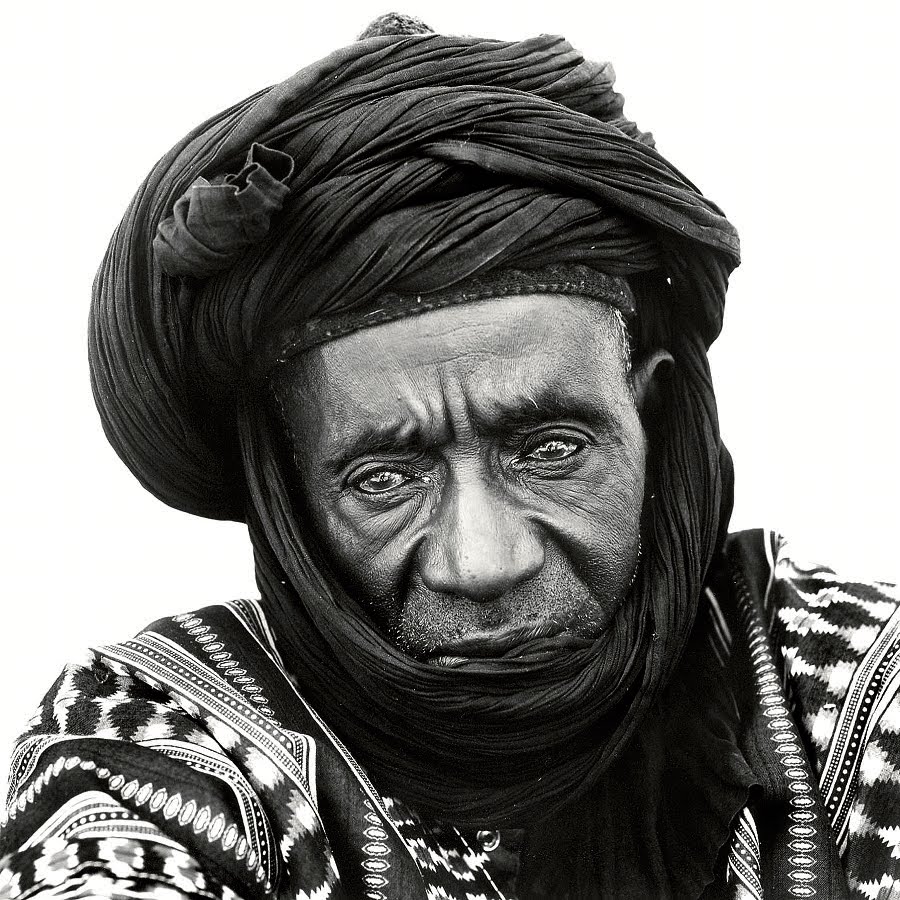
Elder Man, North Bank, The Gambia

He sat on the side of a service station, and mostly remained quiet during negotiations for the portraits. Although slight in build, his features impressed me deeply then and even more so now. He was hundreds of miles away from his family and did so in order to make a living. I wonder where he is now, and if he has rejoined his family.

Unframed $650
Framed $800
Smaller Prints Available
100% of proceeds going to Schools for Girls in association with
Humana People to People India


Claudia, Artist, San Miguel del PadrĂ³n, Cuba

She loves to paint and in life happens to be the quietest of girls. Her presence in front of the camera however is without equal and she has over the past two years spoken through the visual image unlike any other in my experience. We met one day while looking for her sister from the previous year, and instantly fell in love with her spirit. She has the humility that the lens adores, and the kindness that allows me to continue documenting. Before leaving her home, she invited me to her room with the permission of her father to witness her paintings. I sat on the floor next to her bed while she passed her paintings one by one for my review. The colors were magnificent, and I felt like an explorer seeing a landscape for the very first time. As we ended our visit she handed a painting to me as a gift, a gesture that touched me beyond my ability to respond verbally.

Unframed $650
Framed $800
Smaller Prints Available
100% of proceeds going to Schools for Girls in association with
Humana People to People India


Sunday, January 10, 2010

Mauritanian Man, Service Station, Northern Road, The Gambia, 2006


We set off from Dakar, Senegal to Banjul, Gambia. Our guide and driver tells us that we are to drive along the coast and arrive in about twelve hours, perhaps more depending on the photography.
He then hears us talking about wanting to see more and, in one split second, makes a decision to enter Gambia from the East. We look at each other and answer in the positive, thinking that surely we will see more.

Little do we know the terrain, the distance.

The plans change all of a sudden. He decides to drive much faster in order to reach a small town just inside the border between Gambia and Senegal. Photography has taken a back seat alongside me.
We arrive at a small border crossing, the men are at prayer. So we wait alone.

They come back, review our papers and chat a bit before letting us through.

It seems like every other mile someone wants to see our papers. We oblige, they stamp the passports and we move forward. The sun sets and we continue forward. Finally we arrive at this small town to find out that the driver's family has a home here. It seems a little coincidental to us but we are glad nonetheless. He drives us to the small motel nearby.

Because the sun has set, we take our gear and walk in complete darkness to our rooms. We are shown inside, given a half candle for light. Our driver then leaves to see his family and informs us that he will be back sometime tomorrow. In response, he comes to understand our need to leave before sunrise and hesitatingly answers in the affirmative.

We go back to our rooms, light the candles and hurry to wash ourselves before the candle burns down. The plan goes well, washing is accomplished and my eyes are almost closed as the light from the candle expires. The rest of the next hour before sleep my mind imagines the rest of the room with much anxiety.
We wake up the next day, have a wonderful breakfast and are treated like royalty by the host of the hotel, a young man that has inherited the place at such a young age. The driver arrives at his own pace and we all meet in front of the hotel. The young hotel owner looks at the car and asks us how we are to cross Gambia to Banjul. We point to the car and he lets off a less than reserved laugh.

We then look at each other and then at the driver who then answers that we are to take the good road, the northern one. The young hotel owner still laughs, albeit a little less knowing that he worried us with the first laugh.

We take off and realize that five to fifteen miles an hour is the pace. At this rate, we wonder how we will reach the eastern shore of the river in time for the ferry to take us to the western shore where the hotel sits. With this in mind, the driver decides to move a bit faster and without stopping for photography. We manage to convince him here and there to stop and make some images.

The above portrait is made at a service station as we stop for fuel. A man and his friend approach our car as we stop, asking us for a small donation. We decide to make it mutually beneficial and ask them for their portraits. They agree, we make the exchange and they sit down against the western wall of the service station for their portrait, the sun is still to the east.

His portrait is made first, then the portrait of his younger companion. The first few exposures are made with his lips covered. Then he pulls the fabric down to allow his lips to show, resulting in the above portrait. He gives me more today than anything that can be given in return.


Tuesday, September 15, 2009

International Children's Day, Habana, Cuba, 2008

He sits on a ledge during International Children's Day, taking a break from the festivities on his block. Just an hour or so ago, he allowed me to make his portrait formally, along with the other children from his street.

The children are running around, singing songs, watching their friends stand in front of them acting out their fantasies. Every now and then a child walks over and has his/her portrait made by me. My friends and I walk around and make spontaneous portraits of them in return.

On every block there is such a scene. On this small island, the love of children is noticeable. The streets are playgrounds for the children, with everyone watching out for the children of others. On this special day, endless effort is spent gladly for the sake of the children. They take the little that they have and spend it on balloons, decorations, cakes, cookies and so on.

This is International Children's Day and it shows.

Living in the States for over thirty years has rarely given me a glimpse of this day, in one of the most affluent nations on Earth. Walking around Cuba has taught me lessons missed over those thirty years, has taught me the value of such sharing.

Writing of such brings another story to mind. When walking around Gambia one day, Spanish is heard as a man walks by talking to two guides. I turn to my friend and ask about this stranger. My friend tells me that he is a Cuban doctor taking care of villages lacking any medical facilities.

It seems that the lessons learned during International Children's Day last a lifetime.


Friday, July 31, 2009

Upside Down Tree, Gambia, 2006

On the way back from Banjul, we cross the Gambia River and visit a fort at the mouth of this body of water as it exits into the Atlantic Ocean. We happen to be the only ones and a young man approaches us to act as our guide. He tells us of its history, its transition from protecting the slave trade to helping end it.

When we first arrive, a small van is parked underneath this tree. We move along with the tour and then decide to get back on the road to Dakar. Just at that moment, I notice that the van is gone. The portrait of the 'Upside Down Tree' is made against the backdrop of history.

As our generous guide explains, the British soldiers thought this tree to be a bit odd, with its branches lacking leaves for much of the year. The named it the 'Upside Down Tree' because its branches resembled the roots of a traditional tree. Whether he is telling its history or merely entertaining us matters little, we enjoy his company.

He makes one more point, with the life of this very tree perhaps being over five hundred years old, it stands as a witness to the entire slave trade as it moved in and out of the Gambia River, from its inception to its decline centuries later.

How many lives passed by this tree? How many faces did it bear witness to over the centuries? Was this the last tree that the slaves might have been able to see as they were removed from the continent?

Only this most beautiful of life forms has the answers.


Monday, June 22, 2009

Woman, Gambia, 2006


She walks out from behind a simple fence, with two of her friends. They watch us getting ready to leave after making some portraits of the kids in the street. They wonder what we are doing and ask our translator some questions. Instead of the usual, they ask to have their pictures made. The sun is really high at this time and it is really out of my comfort zone. Nonetheless, we take our equipment out and make their portraits. They stand next to the car and face the sun. A few older men walk by and ask questions also, all of whom allow us to continue. We make less than six images each, pack our gear and head out to the next stop, a fishing village near the beach. We are on the coast of Gambia and the smell of fish is everywhere.

Monday, June 15, 2009

Gambia, North Road, 2006


It is a rough day on the road from Dakar, Senegal to the interior of Gambia. We arrive on the eastern border of Gambia the previous night and spend the night in a small town. The plan is to leave in the morning and arrive at the western coast by the end of the day. The hotel owner smiles when he sets his eyes on our transportation, a compact car. He seems to know what lay ahead of us. This is the background behind this portrait. On our way west, we stop for gas at a service station. This man and his friend are sitting on the side, waiting for the next car. He walks over to us and asks for some help. After a minute or so, we agree on an exchange, his portrait for our help. He agrees and sits down for the portrait. At first, he covers his face, then he lowers the cloth enough to show us his face more so. This is one of the few portraits made by me in exchange for something more than a print, something outside the venue of my collaborations. It works out well and his portrait is used in order to raise awareness of the others in my portfolio.