Showing posts with label Nomadic. Show all posts

Tuesday, November 12, 2013

Girl, Banjara Community, Rajasthan, India, November 11, 2013

Over and over again these girls impress me, how they are approached spontaneously and yet they are able to stand in front of dozens of people, mostly men, while providing expressions rarely seen in their own community.

This morning a little woman stepped in front of the lens in a small Community of Banjara. While the older girls found it nearly impossible to do so, she acted without fear. A roll of medium format film was changed yet her fierceness never waivered during the wait. Boys ran all around her, and men showed their disapproval at times, yet she stood her ground.

As the hour of photography passed the men became even more anxious, they wanted their own time… this even after just twenty or so minutes of photography. This almost amazes me as much as her fierceness in that the former never changes, men always want their time even though the photography is designed for the younger members of their community. The children obviously are enjoying themselves, yet the men find it in themselves to put this joy at risk by pushing their own agendas.

While standing for the girls has its own risks, to this day I try to maintain the session for the girls until all are photographed, then move onto the men albeit in a less enthusiastic manner internally. The fact that a smaller, faster camera is being used, added to the color of the images, seems to do the trick most of the time. This time I'm just happy that six girls were photographed before the rush of men overtook the session.

Tomorrow a wedding takes place and I may accept their invitation to attend. Hopefully I'll be able to make it, and see her under different circumstances.

halim.ina@gmail.com
Halim Ina Photography

Saturday, December 15, 2012

Young Girl, Banjara Community, Humana People to People, Rajasthan, India, Morning of November 21, 2009

While working with the good people of Humana People to People India, I was introduced to the Banjara Community. On the first day of my first visit I arrived to a festival arranged by the foundation, at which I saw the most beautiful, young girls dressed in exquisite, imaginative fabrics. The designs ranged from floral to abstract, and were worn tightly against the upper torso and loose from the waist down in pleated skirts.

Four years later during my last visit to the projects of Humana People to People India, we had an opportunity one morning to visit on our own time a few villages populated by the Banjara Community. Once again my work was fortunate enough to be given this chance and we decided to leave quite early in the morning to arrive as the sun lifted above the horizon.

The drive was as always a beautiful experience for me. Waking up very early in Rajasthan during November is always a cold experience. Usually there is a mist and everyone is moving about gathering themselves for that day's work. You see men huddled around a fire, or maybe a coffee stand, warming each other up in small circles.

We arrived at the first village only to find out that the girls were taken to the town for school. This happened to be a sporadic event and today was the day the government school decided to pick them up for classes. I was quite sad at the news (happy for them of course regarding their education) but did see a chance to photograph a few children remaining behind perhaps because of their age.

We asked to photograph the boys first, always a good idea, and they agreed quickly. We then photographed a couple of young girls, always keeping an eye on the young man in charge so as to make sure that he feels comfortable with the attention being given to the girls. The young girl above happens to be one of the girls left behind by the bus, and she was perhaps glad that she missed classes on this day. Only she knows if this is true.

Humana People to People India works with these and other communities, providing an education as a starting point. Once these children attend classes for three years they are encouraged to join the formal government school system, having caught up to their peers through the bridge schools HPPI offers. Many of the Banjara children work in the local towns as maids, as gatherers of plastic/metal/glass and so forth.

They live an existence that is day to day, and move from one area to another sometimes because they are forced to do so by the local populations. They lack proper identifications at times and are denied basic social services as a result. I admire their strength and tolerance towards me and my work, and hope that one day the world around them will appreciate their beauty as much as I have since that first day back in 2006.

halim.ina@gmail.com
Halim Ina Photography

Tuesday, December 11, 2012

Mursi Man & Cane, Lower Omo Valley, Ethiopia, March, 2012

During my time in Ethiopia, I visited a dozen communities. Each experience had its own feeling, its individual flavor. We only had three weeks to accomplish these visits and so set a limit as to time spent with each, at least until I met the Mursi Community of the Lower Omo Valley.

After one session I knew we would stay put for the next five or so days. In order to photograph them we needed to stay in a nearby town, about one and a half hours away through rough, mountainous terrain. Because we needed to photograph as the light appeared and disappeared, this made it most difficult for our driver. The road up and down the mountain was barely a road, just a path actually. On either side of the mountain were dangerous slopes, easily engaged in pure darkness.

The Mursi live in a national park, and thus are quite remote from any possible accommodations. We arrived one day early because we were seeking a local hospital to take care of my health. Seven days prior to our arrival I had been unable to eat anything substantial, and anything that did go down came back up quickly. I lost perhaps a dozen pounds in less than six days, but continued to work because the energy of the place was irresistible. 

When we arrived to the small town, we visited the local hospital. There were many people already gathered for the attention of one physician, people with issues ranging from broken limbs to pregnancies to infections. I felt quite awkward being there for something so superficial, but knew that I needed this man's help. For the past few days tremors crept in whenever I moved a muscle, and this scared me very much. Every time I would try to stretch out in the truck my muscles would seize, every time I would move in bed while sleeping cramps would set in.

When my time came the doctor and his team saw me without prejudice. In perfect English he went on to explain how he was going to diagnose my ailment. He asked question after question, alleviated my concerns and then made a diagnosis based on his interview. He provided me with two prescriptions to be filled in the pharmacy next door. When we attempted to pay for his services, the doctor refused payment in the kindest of ways and included me in the social contract of the region. My visit alone with this gentle man gave me a sense of peace, and the medicine (for the price of one cup of tea) cured me in one evening. The very next day I was able to eat, and do all else associated with normal bodily functions. Sleep was finally available to me.

So we arrived to this community reinvigorated, and worked from sunrise to sunset. In between we would drive to a secluded spot and have our meals, and chat amongst ourselves. One night we were allowed to sleep near their homes, and thus were given rest between driving back and forth. During this night we set up our tents, and made a dish that included spaghetti and corn. We thought we were alone, but then found ourselves in the company of these good people as they arrived to our campsite with their machine guns in hand. Rather than being alarmed we felt safe, and slept through the night looking forward to the next day. 

While my time in Ethiopia was overall the most difficult photographic experience of my life, it was also amongst the most fulfilling in light of the images made. I do look forward to one day revisiting these communities and being more familiar with their customs, lending a more authentic feeling to our communications. 

halim.ina@gmail.com
Halim Ina Photography

Saturday, June 19, 2010

Mursi Man, Earrings, Lower Omo Valley, Ethiopia, March, 2010


This portrait is the morning after the portrait below, in the middle of Mago National Park.
The night before we sleep near a stream and under a large tree. For our dinner, we have corn from the previous day and some canned tuna. While we sleep, a guard from the park services department watches out for us along with some men from his tribe, the very tribe we intend to photograph the next morning.
The reason for the decision to camp is based on the amount of gasoline remaining for the trip. Sleeping near the tribe allows us to eliminate the arduous trek over the mountain range and also lessens the wear and tear on the truck, as well as the driver.

Clouds, for some reason in the land of sunshine, decide to appear on the horizon just as the sun is shining most beautifully this entire week. Sleep is hard to find all night because of this. Every once in a while, I unzip the small tent and look up at the skies only to see stars. Then I go back to sleep only to repeat this a few times during the night.

In the morning, before the sun rises, I check on the sky one more time, seeing only stars. Excitement builds and we decide to move quickly. We pack all of our gear, place it on top of the truck and head to the village only a minute or so away.

As written in previous posts, a tribe that is supposed to be most difficult is in actuality more than gentle. We begin with the girls, then the women and then the older men. During this morning's session, a large cloud appears out of nowhere unexpectedly and seems to be moving in the same direction and with the same speed as the sun.

With the previous five days in mind, I almost decide to put everything away and give up. The translator tells me to be patient, tells me that the sun will reappear in less than one hour. In the end, he is right. The sun does reappear and even though it is higher and stronger than before, the people are able to stand up and collaborate beautifully.

We finish on a high note and move on to the next tribe, until our return next year hopefully.

Thursday, May 6, 2010

Mursi Man, Walking Stick, Mago National Park, Lower Omo Valley, Ethiopia, March, 2010


So we finally decide to get out of the truck and complete this village. We have been waiting since the morning session under the hot sun, under the shade of some short trees on the side of the road. The men of the village have been waiting beside us as well. They have been playing a game, talking and just enjoying each other's company.

So we find a spot about 50 meters from the shade of the trees. We go to call the first man and the mood is different. It seems that they have changed their minds about the negotiated price. In the morning, we photographed the children and the women for an agreed-upon price. The men now feel that their portraits are worth more. The young man above is in charge of the negotiations on behalf of the men.
 
The men with me begin talking once again. The conversation goes back and forth with nothing accomplished. The men grow impatient, complicated by the fact that a few of them have begun drinking the local alcoholic beverage. This worries the guides because of stories they have been told before our arrival.

As the sun begins to drop, it becomes more apparent to me that we need to move forward. With my guide's permission, I ask to speak directly to the older men, with the help of the young man above. My english is translated to Amharic by my guide and then to Mursi by the young man above, under the Surmic family of languages.

The point is simple; we agreed on a price in the morning, photographed the girls and women and now would like to do the same for the men. We feel that an agreement has value and we also feel that all are equal in our eyes. Therefore to value one person's photograph over another's portrait is inappropriate.

After hearing this, the men agree to be photographed for the same price as the women and the photography begins, to everyone's amazement. While surely naive of me, this experience reaffirms my trust in the general human experience, in a universal understanding.

Thursday, April 8, 2010

Man, Service Station, North Road, Gambia, Summer, 2006


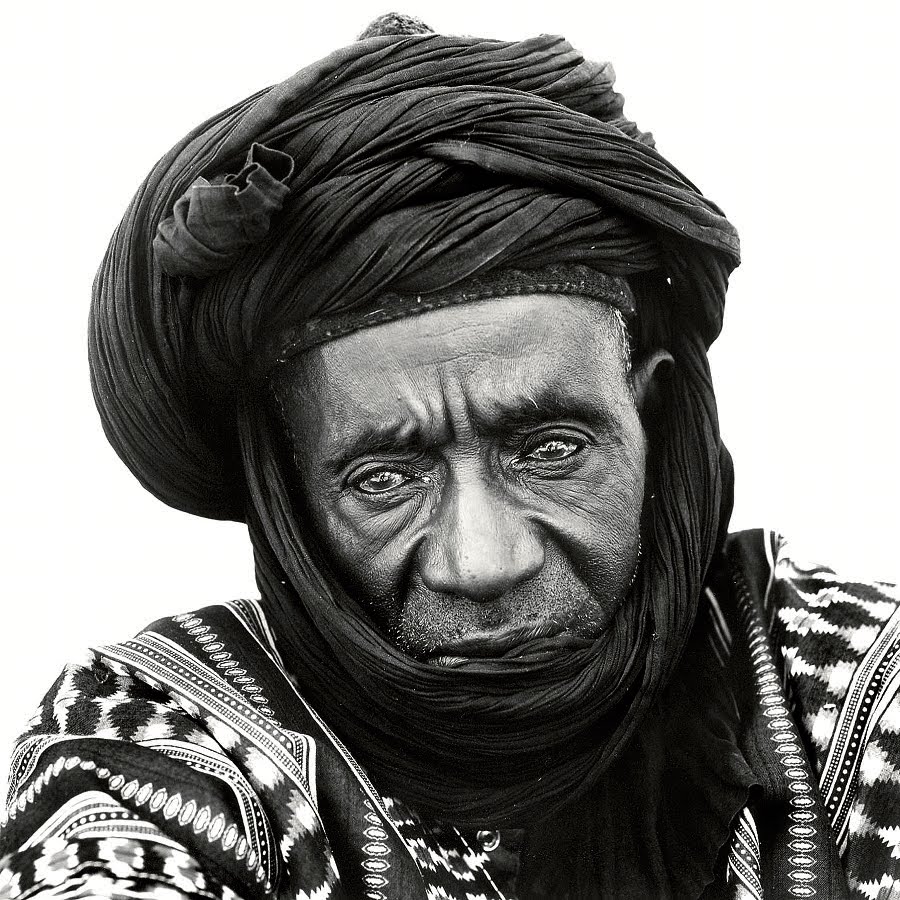
Earlier in this blog is a portrait of his friend, another man from Mauritania. Rather than in his land, this portrait is made on the side of a road in Gambia. On our second day in this country, we stop for gasoline and see him sitting along with his friend, an older man. We are heading West in the direction of the capital Banjul for a few days of photography. 

They politely ask for our help and, seeing an opportunity, we agree to do so in exchange for their portraits. They agree nicely and walk over to the western wall of the service station. It's early in the morning and the sun is to their backs, behind the building. They sit down on a raised cement step, with a white wall as a backdrop. 

He comes from a land where there are deep divisions, between black and white, between Arab and African. In his country, almost 20% live as slaves, true slaves with masters. He is in Gambia searching for work, looking for a way to support his family.

Wednesday, January 13, 2010

Once a Stranger, a Sister Now, Studio, States, January 10, 2010


With Chris is Courtney.

This portrait is made during our second session, a result of happenstance.

While getting her dress together a few minutes earlier, a piece is accidentally removed by Chris, putting a look of a child in trouble on his face.

While loading my film, Courtney places this piece around her neck as natural as can be.
We end up making portraits for about an hour using this piece; the look of trouble on Chris' face is replaced with one of happiness.

This experience takes me back to the photography overseas, where the girls play with pieces of clothing while waiting for their turn. They see my reactions and then act upon them, noticing my attraction to darker pieces of clothing and exchanging between themselves those same pieces.

Courtney and Chris do the same in my studio, going back and forth. They act in the moment, share their enthusiasm with me and show me what it means to give without reservation. The afternoon turns into the evening, the evening into the night, all without notice.
We separate only to join again next weekend.

Once a Stranger, a Brother Now, Studio, States, January 10, 2010


He comes along with Courtney the first time to my studio, makes himself almost invisible for the sake of the work. When asked to be photographed, it is with the joy of a child that he accepts.
We make his portrait. The sense of respect that he shows my work is immense, for he notes it in his every word. To join his brothers and sisters from around the world gives him an tremendous sense of pride, of happiness.

This is a man who has much to share with us; the scars on his body are reminders of such.
He visits my studio on two occasions, the latter of which results in the image above. This time around, he is less reserved, less shy. He comes prepared with a change of clothing, he has put some pieces together for the session. He reminds me of the children from my work overseas, taking little for granted.
He teaches me that such humility can be found on both sides of the ocean, in every land.

Sunday, January 10, 2010

Mauritanian Man, Service Station, Northern Road, The Gambia, 2006


We set off from Dakar, Senegal to Banjul, Gambia. Our guide and driver tells us that we are to drive along the coast and arrive in about twelve hours, perhaps more depending on the photography.
He then hears us talking about wanting to see more and, in one split second, makes a decision to enter Gambia from the East. We look at each other and answer in the positive, thinking that surely we will see more.

Little do we know the terrain, the distance.

The plans change all of a sudden. He decides to drive much faster in order to reach a small town just inside the border between Gambia and Senegal. Photography has taken a back seat alongside me.
We arrive at a small border crossing, the men are at prayer. So we wait alone.

They come back, review our papers and chat a bit before letting us through.

It seems like every other mile someone wants to see our papers. We oblige, they stamp the passports and we move forward. The sun sets and we continue forward. Finally we arrive at this small town to find out that the driver's family has a home here. It seems a little coincidental to us but we are glad nonetheless. He drives us to the small motel nearby.

Because the sun has set, we take our gear and walk in complete darkness to our rooms. We are shown inside, given a half candle for light. Our driver then leaves to see his family and informs us that he will be back sometime tomorrow. In response, he comes to understand our need to leave before sunrise and hesitatingly answers in the affirmative.

We go back to our rooms, light the candles and hurry to wash ourselves before the candle burns down. The plan goes well, washing is accomplished and my eyes are almost closed as the light from the candle expires. The rest of the next hour before sleep my mind imagines the rest of the room with much anxiety.
We wake up the next day, have a wonderful breakfast and are treated like royalty by the host of the hotel, a young man that has inherited the place at such a young age. The driver arrives at his own pace and we all meet in front of the hotel. The young hotel owner looks at the car and asks us how we are to cross Gambia to Banjul. We point to the car and he lets off a less than reserved laugh.

We then look at each other and then at the driver who then answers that we are to take the good road, the northern one. The young hotel owner still laughs, albeit a little less knowing that he worried us with the first laugh.

We take off and realize that five to fifteen miles an hour is the pace. At this rate, we wonder how we will reach the eastern shore of the river in time for the ferry to take us to the western shore where the hotel sits. With this in mind, the driver decides to move a bit faster and without stopping for photography. We manage to convince him here and there to stop and make some images.

The above portrait is made at a service station as we stop for fuel. A man and his friend approach our car as we stop, asking us for a small donation. We decide to make it mutually beneficial and ask them for their portraits. They agree, we make the exchange and they sit down against the western wall of the service station for their portrait, the sun is still to the east.

His portrait is made first, then the portrait of his younger companion. The first few exposures are made with his lips covered. Then he pulls the fabric down to allow his lips to show, resulting in the above portrait. He gives me more today than anything that can be given in return.


Thursday, December 3, 2009

Banjara Girl, Alwar District, Rajasthan, India, November 10, 2009

They tell me that a young Banjara man happens to be working in the Sunset Hotel, a remarkable fact since this tribe has caught my attention from the first day in Rajasthan four years ago. We meet him and he offers to take us to his family's community. We accept and meet in the hotel the next morning, before sunrise to make the long trip.

According to many accounts, the Banjara are typical nomads that wander from place to place in search of a living. In my experience, some of these communities have made homes for themselves on government land and have even acquired ration cards as well as participation in the voting process, both of which many in these communities usually lack.

Their manner of dress has influenced my search for them. Their girls and women wear a combination of a skirt (ghaghra) and a blouse (choli), with the skirt being quite long and reaching to the ankles, which are also usually adorned with anklets. Their jewelry is in much demand inside India and outside as well.

Unlike many other communities, they are quite resistant to photography. They have had multiple experiences with people offering schools, financial assistance and the like. They have always been disappointed when those same people disappear shortly thereafter.

As a matter of fact, during our talk with this small community, we are informed that the president of the foundation 'helping' at the moment is in a local jail, serving time for misusing funds. We talk for some time, show them our photographs of other Banjara and they allow us to photograph a few of the younger girls. The excitement builds, the girls change to their more elaborate skirts and we make images for at least one hour, until a relationship is formed for perhaps next year's visit.

Unfortunately, upon our return to the truck, we find two punctured tires and a broken window. Of course anyone walking by is a candidate for this action, but we cannot help feel a sense of sadness in knowing that perhaps our visit to others in the area might have resulted in some ill feeling.

Regardless, this young Banjara girl knows the difference between us and the others from her past and shows us a trust that so few have in their first encounter with us. She is an example for people that have lost these qualities, for those seeking to regain them.


Saturday, August 29, 2009

Collecting the Film, Washington, 2009

Just came back from Washington, D.C. with the film from my latest visit to Lebanon. There are those that will question the use of film today?

There are others that will wonder as to the distance traveled for a good lab?

There are still others that wonder about the underlying value of the work?

Upon my return and seeing this single image, all would be worth it if just for this image.

She is an Arab living in Lebanon, with her home in Syria. She and her sisters work in the fields of Lebanon picking vegetables for less than $2 per day, for perhaps ten to twelve hours. When she returns home, a different kind of work begins.

Her work never ends.

So to drive twelve hours means infinitely less than what she goes through on a daily basis. The above questions fade away as her image comes into view.