Friday, May 25, 2012

National Missing Children's Day, Child, On the Streets of Dakar, Senegal, 2006

In the streets of Dakar six years ago this young boy and two of his friends approached us. They were curious and respectful, had little more than the shirts on their backs and pants just as worn. My mind wondered where they lived, whether in the capital or far away, having come to the capital to find something to earn.

When they approached me I was making pictures of a wall. They seemed nice enough and I offered to make their portraits. They quickly accepted and the portrait above is the result of that moment.

Today is National Missing Children's Day. Even though I lack children of my own, I cannot help but imagine the horror of losing a child, or thinking that one's child is suffering a life on the streets like the young boy above.

Nearly 800,000 children go missing each year in the States alone, and an equal number of girls for example in India suffer a similar fate due to a preference for boys by parents. Regarding the latter more can be learned through the following link:

BBC News Article

I have never forgotten him and hope that he has found a better way.

For more of my work, and to contribute your thoughts regarding this project, please visit the newly designed website below, courtesy of Patrick Luu.

Halim Ina Photography

Tuesday, May 22, 2012

The Last View of Home, Île de Gorée, Off the Coast of Dakar, Senegal, February, 2006

Perhaps this stone has been in this place for ten years, perhaps for two hundred years.

One thing is for certain, this is the view that countless Africans shared as they were removed from their continent and enslaved for future generations to come. On this small island near the city of Dakar they were held, on this small island their lives changed forever.

According to an entry in Wikipedia:

'Probably no more than a few hundred slaves per year departed from here for transportation to the Americas. They were more often transported as incidental passengers on ships carrying other cargoes rather than as the chief cargo on slave ships. After the decline of the slave trade from Senegal in the 1770s and 1780s, the town became an important port for the shipment of peanuts, peanut oil, gum arabic, ivory, and other products of the "legitimate" trade.'

Does the number lessen the horror?

While sitting on this beach making this image, visions of Africans shackled in ships and held standing for sale passed through my mind like a slideshow. One cannot imagine the horrors that must have passed through the minds of the people on this island hundreds of years ago, so close to the African continent yet destined to live in a land devoid of their people, their history, their culture and their language.

They were removed from their continent as Africans and forced onto another as slaves. 

Can one imagine such an experience? How does a language disappear? How is a culture snuffed out? How is a history lost?

The first few generations might have thought, we will never forget. How can we ever forget?

As decades turned into centuries, I imagine that these questions must have dissolved as well.

I can never come close to understand a single millisecond of the above, but can appreciate the view above, a view of the unknown.

For more of my work, and to contribute your thoughts regarding this project, please visit the newly designed website below, courtesy of Patrick Luu.

Halim Ina Photography

Friday, May 18, 2012

Yet Another Girl, Banjara Community, Humana People to People, Rajasthan, India, November 25, 2008

A friend of the girl from the previous post, she belongs to the same community of Banjara.

On Thanksgiving Day of 2008, we make her portrait on the rooftop of the school building. Her expression is represented on the tenth frame of the twelfth roll of film on this spectacular afternoon. We walk around town from one cluster to another, treated to the most beautiful of spirits.

While hardened to the streets from my observations, within their neighborhoods it is an entirely different world. Rather than approach me as a stranger and with the thought of collecting donations, they approach me on this day as a contributor to their schools and offer themselves to my camera.

Children come running from every corner and chaos it seems is the order of the day. However when one child steps up all the rest allow their friend to have a portrait made. Only when time comes for the next person does chaos return. Like waves landing on a beach, there is a rhythm to the process.

With the introduction of Humana People to People to India came the Academy for Working Children. As written by HPPI:

Humana People to People India runs Academy for Working Children. The idea of the program is to provide basic education to the migrant workers children in industrial areas of India. The project responds as well to the child labour issue by providing a chance for the children to pursue education to have a brighter future and teaching the parents to value the children's education.

Their work invigorates me, gives me more reason to follow through with these images. Without asking for anything in return the good people of Humana People to People invite me into their villages. They are just happy that these children get access to someone and something different from their routine.

After six years of documentation it is time to do something more, to perhaps involve myself more so. This is the thrust behind the current movement to locate funding for five schools. I have worked with two other foundations in India and have nothing but respect for them. I look forward to visiting Rajasthan in November of this year and to perhaps seeing these schools filled with children like the young girl above.

For more of my work, and to contribute your thoughts regarding this project, please visit the newly designed website below, courtesy of Patrick Luu.

Halim Ina Photography

Wednesday, May 16, 2012

Banjara Girl, Humana People to People, Rajasthan, India, November 25, 2010

This young girl and her community enchant me to this day.

As with most of my work from India, the portrait is made from below with the bluest of skies as the background. She stands on a chair and on the roof of her school. I sit in the stairwell and move every time another girl steps onto the roof past me for her portrait.

We are very careful to make sure it is one child at a time and that the child is nowhere near the edge of the building, since the roof is flat without any walls surrounding. Her community, the Banjara, is a minority yet numbers perhaps near six million in this land of diversity.

The name of their community is derived from a Sanskrit compound word meaning 'Forest Wanderers.' One source tells of their role in the salt trade, from the Indian Ocean to the interior. Others point to them as the 'Gypsies' of Asia, dispersed as a people to the Middle East and beyond. Their tattoos might be related to the tattoos evident in my work with the Bedouin of Lebanon.

With Humana People to People in India, the children of this community have found a champion. Instead of days filled with trash picking, they have at least three hours per day in a classroom learning to read and to write. It is a remarkable accomplishment in that the surrounding communities see very little worth in these most beautiful children.

A little bit before this portrait was made, we stopped by the side of the road to get some oranges and apples. At the fruit stand a few children gathered around us asking for a donation, and were quite courageous. I knew that they would recognize the faces in my photography book and took it out of my bag to share with them. As the pages turned from faces of strangers to the faces of their friends, they turned into our guides and insisted on showing us to their community.

I asked them if they were going to be in school later. They nodded. I then told them that we will show up later to make their portraits and to tell all of the others to be there. When we arrived later they were all waiting, in their most glorious attire.

I will always follow them and hope that our efforts in the near future can support their humble schools.
For more of my work, and to contribute your thoughts regarding this project, please visit the newly designed website below, courtesy of Patrick Luu.

Halim Ina Photography

Saturday, May 12, 2012

Dinner in Banganga, Students from the School, Banganga, Rajasthan, India, November 22, 2009

As summer approaches here in the States, students will be looking forward to vacation and rightfully so. At the same time in Rajasthan, girls in the villages of my photography will continue their chores without change, for their schools were closed two years ago in spite of exemplary efforts from Humana People to People India.

At the time of this image, the school was still functional. The woman standing to the right of the frame is the mother of these two young girls, also their teacher in the village school. She watches over them as they prepare our meal. They consider me a part of their family and I consider them in the same manner. They have been with me since the beginning of my work in Rajasthan, and will be with me for as long as I am able to visit them.

In this room they make one of my dinners, with the second of my dinners being made just next door by their aunt. They find it a bit comical and enjoy watching me attempt to finish two meals, one after the other. They must see the sweat on my forehead and my need to drink glass after glass of water. Regardless, or perhaps of such, they continue to feed me in some effort to make sure that my return home is a healthy one.

Every ingredient in their meals comes from the earth around them, and tastes like nothing in my culinary experience with the exception of my Mother's cooking, and that of my family in Lebanon. Their ability to do everything for themselves impresses me continuously, even more so with the girls of these two families. Everything they do seems effortless. Watching them makes me feel quite useless actually, distant from the land that nurtures all of us.

We have received some wonderful news this past week and look forward to the possibility of the reopening of five schools. We are now looking to increase that possibility through our network and hope that the readers of this blog will find inspiration to be a part of this project.

For more of my work, and to contribute your thoughts regarding this project, please visit the newly designed website below, courtesy of Patrick Luu.

Halim Ina Photography

Saturday, April 28, 2012

Master Joe, Willoughby School of Gung Fu, Early in the Morning, April 28, 2012


Earlier this morning this image was made in collaboration with Master Joe and Willoughby School of Gung Fu. This is the second in a series of collaborations and one that will hopefully continue through the years. In the image above he is complimented by his incredibly talented son, Vincent.

The beginning of our session is spent making portraits of certain movements, positions. For my sake they move from one position to another slowly and with sufficient space to allow me to catch up with them. They are an incredibly dedicated team. After an hour or so, we ask Anna to step in front of the lens and she does so as in our last session, with grace and confidence.

I enjoyed our first collaboration and the second collaboration even more so. Anna by now understands me, my work and my vision for her. She moves from one pose to another freely and looks at the camera with familiarity and courtesy. Most of her images today were made on film, and will be shared with her in the near future. If she is reading this blog entry, she will learn that my vision for her extends for as long as photography is my life.

In the second half of the session, Master Joe and Vincent present themselves in a more spontaneous manner and in a more physical manner. The tripod is set aside and images are made of them in action, as much as can be done by an inexperienced photographer in this genre. I do look forward to our next session and the possibilities inherent in a long photographic relationship.

Tuesday, April 24, 2012

Student & Uniform, Humana People to People India, November 13, 2009, Banganga, Rajasthan, India,

The meaning behind the present search for funding sits in front of us in her school uniform. Her school as well as nine other schools are the subjects of my latest blog entries. We aim to help fund these schools and in turn provide an opportunity for her and others like her to attend classes. What some might take for granted she watches from a distance.

Humana People to People India has offered to reopen the schools on our behalf should we be able to find the funding. A small amount would reopen her school, and a relatively larger amount would fund all ten schools. For the price of one year's tuition in a private university, or $30,000, all ten schools can reopen and educate almost 400 girls in Rajasthan. This is surely an important task and one deserving of our devotion.

Sure, they are someone else's daughters, some other nation's responsibility.

However, when parents are unable to personally fund such a project and when a nation turns a blind eye to its citizens, it's an opportunity for those from the outside able to do so to do so. She comes from a small village called Banganga, as beautiful as any heaven described by any faith. Fields as far as the eye can see produce wonderful food, and the skies during many months are as clear as the bluest of skies.

Children play in the fields without worry, and families are extremely close to one another. I have been welcomed into this village like a brother, and have had many dinners and countless cups of tea as a result of their deep hospitality.

Join me and these girls should you be able to do so. You may view more images and contact me through the newly designed website courtesy of Patrick Luu.

Halim Ina Photography

Tuesday, April 17, 2012

Then a Girl, Now a Woman, Humana People to People, Rajasthan, India, November 15, 2009

She remains a mystery to me, here with her new family and six years ago as a new face in my work from a collaboration with Humana People to People India. In her first portraits the smile is missing, and in her later portraits the smile is ever-present. Since her days in the Girls Bridge School of Humana People to People India, she has married and gone on to a life with her new family.

Is she holding her own child or is she smiling at my curiosity while holding someone else's child? Are they both laughing at my lack of knowledge, albeit in a sweet manner? I of course am clueless especially in light  of my missing translator, and play along while making pictures for them. It seems the most natural thing for me to do.

She attended the school for perhaps three years until it was forced to close. She at least learned to read and to write, and to see one of her own friends become a teacher. She has seen another way and will perhaps pass this onto her children. Such is the power of education, it can be transferred from one generation to another without limitations, with little need for books or a classroom. Once it is introduced into a population, the possibilities are endless.

We are hoping to help fund the school in her village once again, and look to you for support. All ten schools may be funded for less than one year's enrollment in a private university in the States. While this is a considerable amount here and elsewhere, four hundred girls will be introduced to learning in a classroom for this amount in Rajasthan.

For more of my work, please visit the newly designed website below, courtesy of Patrick Luu.

Halim Ina Photography

Saturday, April 14, 2012

Girl Sitting in the Back Row, Sample Image, Humana People to People, Rajasthan, India, November 17, 2009

Made with the instant camera, this is a portrait of a student from the same village as in the last post. As a matter of fact she is sitting in the back row trying to hide while holding up a child. The sun has just begun to show itself and she is one of the first to be photographed. A few of the older students stepped up first and she is the first of the younger girls to show herself to the camera.

The landscape behind her surrounds her village. Her clothes are lovingly attended to over they years, handed down from previous generations. Evidence of this love can be seen in the stitching and the pride in her face. This is how she choose to present herself to us.

This image was made perhaps around 8:00 a.m. on this beautiful morning, with blue skies all around. We hope to help her school reopen and to see her later this year attending classes.

For more of my work, please visit the newly designed website below, courtesy of Patrick Luu.

Halim Ina Photography

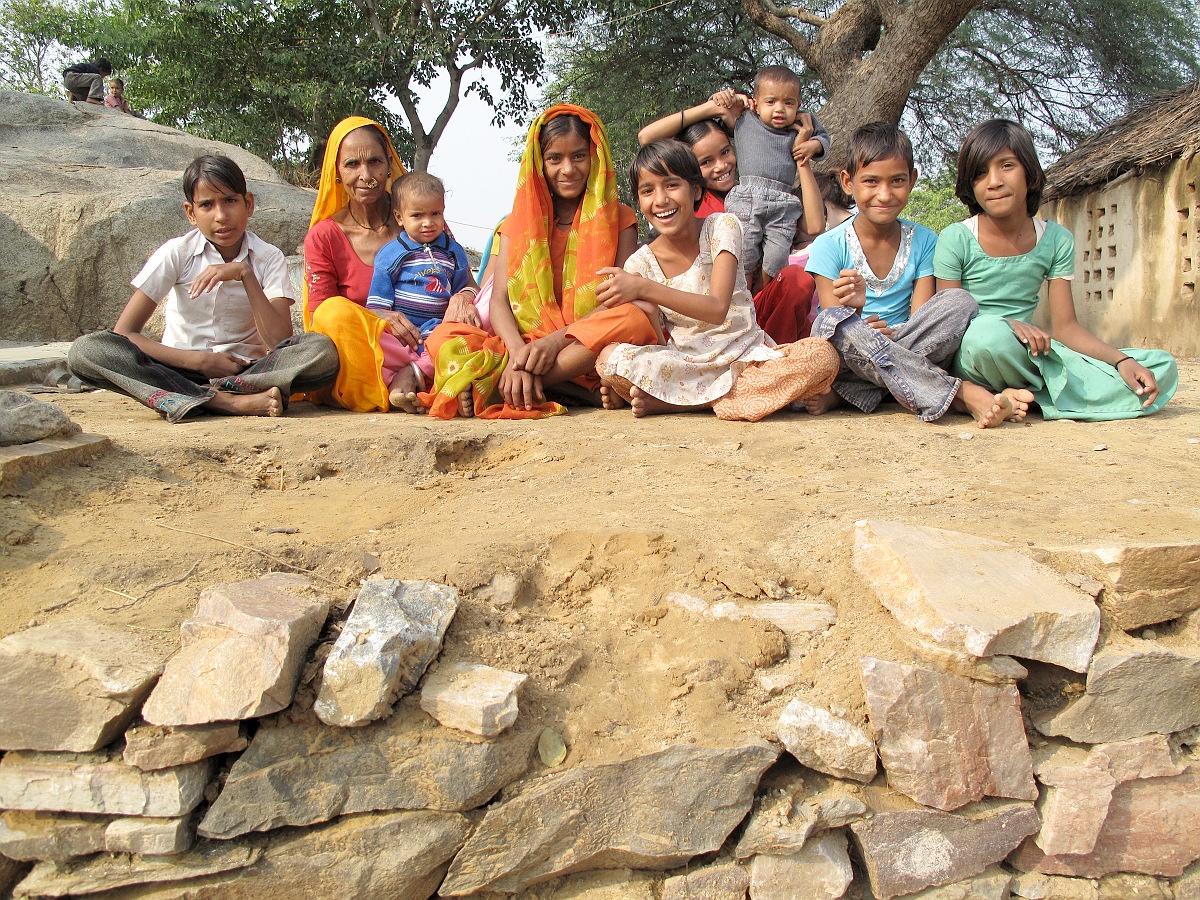
Girls, Students, Humana People to People India, Early in the Morning, November 17, 2009

In the previous post a story is shared regarding an elderly man from this village. The remote location of this village coupled with a certain attitude towards the education of girls in this area has made it quite difficult for the girls to attend school in the past. With the elderly man's permission and understanding these girls have had the experience of a school inside of their own village through the good efforts of Humana People to People India.

Since this image was made the school was forced to close due to a lack of funding. Humana People to People is doing wonderful work in this village as well as in dozens of villages across the countryside in Rajasthan, India. Their work has expanded to various other regions of India and encompasses solar energy projects, micro loan initiatives, farming clubs and so forth. Education is one aspect of their approach, especially the education of girls traditionally held back from going to school.

So we find ourselves once again searching for ways to fund this school and nine others like it. These girls are like girls from all over the world. They giggle for the same reasons, they laugh in the same pitch and long for a chance to become educated. Like economists all over the world, they understand the importance of this most immediate need and will pass on their education to their daughters and sons.

Just before this image we worked for perhaps two hours making portraits of each and every single girl enrolled in the school. They met me in the morning before the sun came up, shivering in the coolness of the morning. The clothes in which they are dressed at this moment are different than the clothes they chose to be photographed in earlier. They know my preference for simpler and darker clothes and blessed me with this single wish. They know my aesthetic limitations and forgive me for such.

I adore these young girls, as I adore spirits persevering when circumstances are most difficult. We will find support for their school quite soon. These are the smiles that await me later this year, perhaps early next year, when I visit them while attending class in their village.

For more of my work, please visit the newly designed website below, courtesy of Patrick Luu.

Halim Ina Photography